Showing posts with label News. Show all posts

Wednesday, 13 September 2017

The Most Interesting Website You Found On Internet

  1. Delete Your Online Accounts - Do you care about your personal data? This website provides instructions to remove your account or public profile on most popular websites, including Skype, Facebook, Windows Live, Hotmail / Live, Twitter, MSN / Messenger, Google and much more.
2. The best free, adless Chess server- Lichess is a free, non-profit Internet Chess Server Its primary aim is to enable a free, "world-class" chess experience for anyone, anywhere. It has 150 000 individual users daily. It does not require registration; anyone can play anonymously. It has training features, including chess basics, tactics training, chess coordinates, and studies.
3Mathway | Math Problem Solver -This website works as an online calculator. However, its bit more than that it can solve almost every mathematics problems. And will give you brief details about the procedure to solve it. So, students who are weak in maths can visit this site.
4. Livestream | Broadcast & Watch HD Live Streaming Video Events- Didn’t get an entry in your favorite event? Don’t worry because Livestream will take care of it and the best part is you can access it from any device.
5Free Email Tracking- Worried that your boss has read your email yet or not? Forget your worries just log in to get a notification and literally get notified whether the person has read your email or not.
6. Send notes that will self-destruct after being read- Want to share something like notes with a little bit of privacy? Then prenote is your solution.This website allows you to share information and is later deleted automatically.
7. Drawspace (Now everyone can draw) - With Drawspace everyone can draw. Have you ever wanted to draw something, but have never known where to start? This website will let you draw something in the easiest way possible. Drawspace provides some great guides what will help you to draw in seconds.
8. Worldometers - real time world statistics - This website gives real time information about population, government, and economics, society, and media, environment, food water, energy, and health.


9. RapidFireArt- Learn how to draw with Darlene's easy to follow tutorials. If you are zero in arts then this will give you in depth knowledge about arts, sketching.

Know Why Google is buying HTC if they sold Motorola


Google purchased Motorola to purchase Motorola’s vast amount of patents and to control them so Microsoft and others couldn't. That was Google’s philosophy at that time.
I question this possible HTC move with your very question, too. I don't get it other than the fact of the Motorola purchase was more defense and the HTC will be more offense. Just a miscalculation on the importance for Google to have their very own Foxconn, I suppose.
At least we got some bad ass phones during those days from Motorola and hopefully, Google could do the same with HTC.
a future for google with a vibe. They have apple and Microsoft both coming out with products in VR and AR. And since their own glass failed, getting vive with htc might be a good deal for Google.
Some Pepople Says it's just business.Google took over Motorola when it was low in market.The same for HTC now.Then Google add a value to it (a Google company) and sell again at a premium.

Friday, 8 September 2017

Apple Leak Reveals iPhone 8 Nasty Surprises

It is clear what the iPhone 8 will get right: its new design, the upgraded (if heavily protruding) camera, a potentially revolutionary unlocking system, and the significant spec bump. But now there is an explanation for two nasty surprises Apple AAPL -0.4%’s new iPhone will also deliver...

‘Great Secret Features’ and ‘Nasty Surprises’ are my regular columns investigating operating system updates for the best features / biggest problems hidden behind the headlines.

Famously reliable KGI Securities analyst Ming-Chi Kuo has spilled the beans in a new report obtained by 9to5Mac and, put bluntly, it’s all Samsung’s fault.


In short, Kuo says Samsung has Apple over a barrel. He reveals Samsung is the sole supplier of OLED panels for the iPhone 8’s headline feature, it’s 5.8-inch OLED display, and as such is demanding upwards of $130 per display.

By comparison, the iPhone 7 Plus LCD display costs Apple only $45-55 and this is the biggest factor behind the iPhone 8’s most unpalatable element: the astronomical asking price. Why hasn’t Apple gone elsewhere? Because Samsung was the only company which was able to supply OLED panels in the quantity Apple requires.

Apple is already trying to fix this. It recently invested $2.7BN in LG to build a new OLED manufacturing plant, though that won’t be ready until 2018 at the earliest. In Kuo’s words: “Apple is in urgent need of finding a second source of OLED.”

But this is just part one. The second area where the iPhone 8 will inevitably disappoint many is its removal of the Touch ID fingerprint sensor.


Again Kuo lays the blame on Samsung’s OLED panels. He claims Samsung was unable to create an OLED panel with a favorable scan-through performance for the fingerprint sensor to operate effectively. Apple was not prepared to copy Samsung by putting the sensor on the back or, like Sony, in the power button so it scrapped Touch ID on the iPhone 8’s completely and will gamble on Face ID handling everything instead.

But Samsung’s OLED is far from the only culprit here. Previous reports have cited the introduction of fast charging and wireless charging, among others, as adding significant additional cost and complexity to the iPhone 8’s assembly.

Cynics will point out features like OLED, fast charging and wireless charging are merely catch-ups and Apple shouldn’t have been so far behind in the first place to feel forced into making them all in a single generation. Then again all these upgrades may just make the iPhone 8 worth both its high price and the omission of Touch ID.

Whichever position you take, we won’t have to wait long for answers. Apple has already confirmed, the iPhone 8 is launching very soon...

Thursday, 3 August 2017

Facebook will prioritize webpages with faster loading speeds in News Feed

It’s a fact that Google takes into consideration website loading time to rank them on the search engine. And let’s face it. A slow website sucks. Nobody wants to hang around these days if a website is a slouch. That is what Facebook just noticed and they are going to make some changes accordingly on their social platform.
In a Facebook blog post, two executives informed users that they were collecting feedback to improve the News Feed. The blog post further read, “We’ve heard from people that it’s frustrating to click on a link that leads to a slow-loading web page. In fact, even more broadly on the internet, we’ve found that when people have to wait for a site to load for too long, they abandon what they were clicking on all together.”
Almost half of the visitors or 40% of them leave a blog if it doesn’t load within 3 seconds. So, in the upcoming months, Facebook will start showing stories that will load earlier and fewer posts that are slow. To achieve this, Facebook will monitor load times of a page. To do this, the user’s network connection and the page which is being loaded will be observed. If Facebook feels a page is fast, then links to that page will rank better in users feeds compared to slower ones.
The above-mentioned changes will be affected via an update that will be pushed in the upcoming months

Updated Google Earth app for iOS brings new features like Voyager, 3D View and more

Google Earth was left deserted in the Play Store for a long time until April this year. Google finally decided to give it some much-needed attention. That was a major update in 2 years. That update included 360-degree video tours, informational cards, Street View and much more. But this new update was issued just for Android and Chrome. Today, iOS gets its fair bit of share.
All the features included in the April update will make it to the iOS app too. Google specifically highlights the “Voyager” feature that helps you to find your next travel destination. There are 140 stories available under it. It gives users a tour of some of the best cities around the world. For starters, you can now visit the brown bears of Alaska’s Katmai National Park. Or maybe you want to visit the past. Then just head on to the “Museums around the world” category.

Google also brings “Knowledge Cards”. These just provide some useful info and facts about the places you are looking at. And if you can’t make up your mind, Google want’s you to hit the “I’m Feeling Lucky” button. Moreover, now you can send postcards to friends. That can be done by snapping a picture from a place you are watching in Google Earth.
Download Link: Google Earth for Android l Google Earth for iOS

Saturday, 6 May 2017

5 Reasons Life is Actually Just a Computer Simulation

How do we know what reality is? It’s a question that philosophers have been asking for thousands of years. With the advancements in computers, that question has been given an upgrade: what if life is just a computer simulation

1. Computers Will Be Powerful Enough

All the way back in 1965, Gordon Moore, one of the founders of Intel, said that the number of microprocessor transistors on circuit boards would double every year. He revised his statement 10 years later, saying it would double every two years.
Today, a number of transistors isn’t as important as making them smaller, but the theory that computing power essentially doubles every year is still relevant. Several experts in computers find that it doesn’t exactly double, but it’s close.
If we maintain that rate of advancement, eventually computers will be powerful enough to run reality simulators. Rich Terrile, a computer expert with NASA, thinks that within 10 years we will have computers that will be able to simulate a human lifetime that lasts about 80 years. It would include every thought that the simulated person ever had, and they wouldn’t know that they were in a simulation. Ergo, it might be possible that is what you’re experiencing right now. Your life is just a first-person simulation and everything in it is
created by lines of code. Another possibility is that the universe is a simulation and we’re all characters in it. There have already been several universe simulators, but the most impressive one was performed by the Harvard-Smithsonian Center for Astrophysics. In 2014, they simulated the entire 13 billion year history of the evolution of the universe in just three months.

2. Reality Doesn’t Exist Until We Look at It

Let’s say you’re playing an open world video game, like World of Warcraft or Grand Theft Auto. What happens to an area of the map when no one is there? Nothing, right? It’s only when your character “moves” to that area that the system processes the lines of code creating the environment.
According to quantum mechanics, reality actually works in a very similar way. Subatomic objects that make up the foundation of reality are usually either waves or particles. However, there are some subatomic objects that can be both wave and particle-like. This includes light and objects with the mass similar to electrons. When these subatomic objects aren’t being observed or measured they sit in a dual state. Then, when they are measured, for lack of a better word they “decide” whether they’ll be a wave or particle-like. This is unusual because logically, their nature should dictate their state, not whether they are being observed. It also means that the foundations of reality don’t exist until we are looking at it.
Physicists aren’t sure why our observation affects how they “decide,” but it is eerie evidence that reality may not be exactly what we think it is.

3. General Relativity and Quantum Mechanics Reconcile if the World is a Hologram

One of the biggest arguments for the simulation theory is that our universe is actually two-dimensional and the third dimension is simply a hologram created by very thin, vibrating strings. This isn’t a whole lot different than lines of code creating a three-dimensional environment in a video game.
Earlier in 2017, a study was published that showed a two-dimensional world is possible and it would help solve one of the biggest problems in physics: how to reconcile Albert Einstein’s theory of general relativity and quantum mechanics. They are the two dominant theories of physics, but they are at odds with each other. Relativity is great at explaining big things like the expansion of the universe and gravity, while quantum mechanics is how nature works at a tiny level, like how uranium decays. In a three-dimensional world they are incompatible, but in a two-dimensional universe, they can be reconciled.

4. Claude Shannon’s Coding

Sylvester James Gates, Jr. is a theoretical physicist who researches stuff like supersymmetry, supergravity, and superstring theory at a level that is nearly impossible for laypeople to understand. We imagine you have to be super people to really get theGates said that he was working on superstring equations with adinkras, which are symbols that are used in supersymmetry algebra, and he supposedly found some possible evidence that the basic foundation of our reality may just be made up of coding. In the equations, he found coding from the 1940s that was written by Claude Shannon, who is considered the father of the information age.
Gates says that: “[an] unsuspected connection suggests that these codes may be ubiquitous in nature and could even be embedded in the essence of reality. If [so], we might have something in common with the Matrix science fiction films, which depict the world where every human being’s experience is the product of a virtual reality–generating computer network.”

5. The Odds Aren’t in Our Favor

According to Nick Bostrom of Oxford University, there are only three possible outcomes for human civilization. First, humans will go extinct before creating ancestor simulators. The second possibility is that humans will develop the technology, but for whatever reason, they don’t run many simulations. Both of those outcomes mean life is real and we aren’t living in a simulation.
The third possibility is that there is a good chance we are living in a simulation. It’s considered a good chance because, while it is certainly possible that humans could die off before learning how to build reality simulators, if future humans did create them then they would probably run them because of humanity’s relentless pursuit of knowledge. They could run an infinite amount of simulations, which would contain every thought and action by every being in the universe for the entire life of the universe.
If there is one reality running infinite simulations, then what are the odds that we’re in the one “real” reality, or one of the infinite simulations?

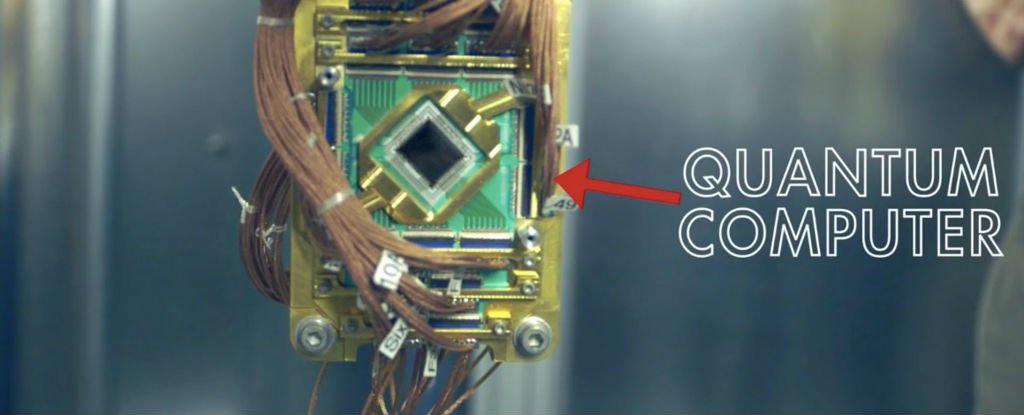
World’s First Quantum Computer Made By China — 24,000 Times Faster Than International Counterparts

A team of Chinese scientists has claimed that it has built the world’s first quantum computing machine. According to them, the machine is 24,000 times faster than its international counterparts and 10-100 times faster than the first electronic computer, ENIAC. While it might not be of any practical use at the moment, it surely shows China’s work in the field of quantum computing.
Image result for Quantum Computer

team of scientists from Eastern China created the world’s first quantum computing machine. The team claims that the newly developed quantum computer is about 24,000 times faster than its international competitors.
This quantum computer is built by the researchers working at the University of Science and Technology of China, which is located at Hefei in Anhui province. For those who don’t know, quantum computing machines are incredibly faster than the conventional computers. The quantum computers can also predict the complex behavior of subatomic particles.
The researchers believe that quantum computing could excel the processing power of supercomputers. Pan Jianwei, a quantum physicist, and an academician at the Chinese Academy of Sciences said that quantum computing makes use of quantum superposition principle for ultra-fast parallel calculation and simulation capabilities.
The Hefei quantum computing machine is 10 to 100 times faster than the first electronic computer, ENIAC. While it might not be of any practical use at the moment, the future prospects of quantum computing look bright.

Compared to the previous proof-of-principle experiments that had small photon number and low sampling rates, the performance of the new machine is better.
“Our architecture is feasible to be scaled up to a larger number of photons and with a higher rate to race against increasingly advanced classical computers,” the researchers said in a study published in the journal Nature Photonics on Tuesday.
It’s the first quantum computing machine based on single photons. This development is interesting to note because, last year, China created the world’s first hack proof quantum satellite.
Did you find this article on world’s first quantum computing interesting? Don’t forget to share your views with us.